
Next deadline
January 15, 2027
Fourth-quarter estimated payment, covering income from September through December 2026. Federal and Maryland are paid separately.
IRS underpayment interest rate this quarter: 7% per year, compounded daily. The IRS resets it every quarter.
There's no paycheck withholding forcing the issue and no tax software nagging you. That's why estimated tax payments are the deadlines self-employed owners, landlords, investors, and S-Corp owners miss most, and why the IRS and Maryland quietly charge interest, compounded daily, on what you should have sent. If you're in Frederick County and part of your income isn't withheld, this is worth ten minutes before each due date.
When you're a W-2 employee, taxes get pulled from every paycheck automatically. You never think about it. But the moment a meaningful share of your income comes from self-employment, a side business, rental property, investments, or S-Corp distributions, that automatic withholding disappears, and the IRS expects you to pay as you go, four times a year, on your own initiative.
Two of the four payments are especially easy to forget. The mid-year installment in September arrives with none of the urgency of tax season, and the January installment lands in the new year, so many people assume it belongs to the next tax year. Both are paying for income you've already earned.
The rule in one sentence: if you expect to owe $1,000 or more in federal tax beyond your withholding this year, the IRS wants quarterly estimated payments, and skipping any one of them can cost you interest even if you square up in April.
| Installment | Income it covers | Due date |
|---|---|---|
| Q1 | January – March | April 15 |
| Q2 | April – May | June 15 |
| Q3 | June – August | September 15 |
| Q4 | September – December | January 15 of the following year |
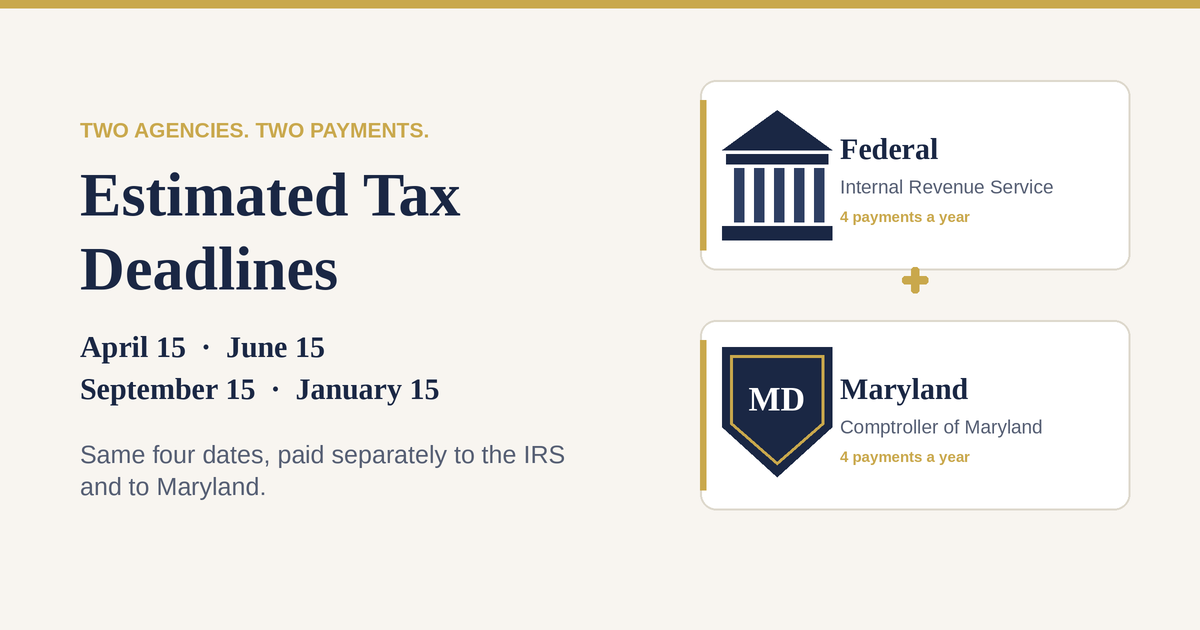
The quarters aren't even three-month blocks, which trips people up. When a due date falls on a weekend or holiday, it moves to the next business day. The date is when your payment must be received or postmarked, not the day you get around to it, and electronic payments generally need to clear by 8:00 PM Eastern. Maryland uses the same four dates for its own, separate payment.
For the 2026 tax year: April 15, 2026; June 15, 2026; September 15, 2026; and January 15, 2027.
The estimated tax penalty isn't really a "penalty" in the punitive sense, it's interest, and it's mechanical. If your timely payments fall short, the IRS charges interest on the shortfall for each quarter it went unpaid. The rate is set quarterly and compounds daily, and it runs from the due date until you pay or until you file. The current rate is in the box at the top of this page.
Here's the part that catches people off guard: you can get a refund at filing and still owe an underpayment penalty. The IRS looks at whether you paid enough in each quarter, not just whether you squared up by April. Pay nothing all year and settle in April, and you'll still owe interest for every quarter you were short, even if your final balance is zero.
There's no penalty at all if the tax you owe after withholding is under $1,000, or if you meet one of the "safe harbors" below. The penalty is entirely avoidable, which is exactly why paying it is so frustrating.
You can sidestep the underpayment penalty entirely, regardless of how much you actually end up owing, by hitting one of two safe harbors. Pay, across your four installments, the smaller of:
The prior-year safe harbor is the one we steer most clients toward, because it turns a guessing game into a fixed number. You don't have to predict this year's income at all. Take last year's total tax, apply 100% or 110%, divide by four, and pay that each quarter. Done, no penalty, no matter what this year brings. This is exactly the kind of number we set for clients as part of ongoing tax planning.
Important distinction: the safe harbor protects you from the penalty, not from the tax. If you end up owing more than your safe-harbor payments covered, that balance is still due at filing, you just won't owe interest on the quarterly shortfall.
The IRS isn't the only one expecting quarterly payments. Maryland runs its own estimated tax system on the same due dates, and it's completely separate from your federal payment. Maryland uses Form PV as the payment voucher, though you can skip the paper voucher entirely by paying electronically through Maryland Tax Connect.
Maryland has its own safe harbor rules and charges its own interest on underpayments, calculated separately for each quarter and set by the Comptroller. Paying the IRS does nothing for your Maryland obligation, and missing the state payment is often the costlier mistake. For the full picture of how the state's quarterly rules work, see our Maryland estimated tax payments guide, and for how Maryland taxes stack onto your federal return, our Maryland Tax Guide lays it out.
The sweeping federal tax law passed in 2025 changed the math for a lot of people. The new tip and overtime deductions, the higher standard deduction, the $40,000 SALT cap, and revised brackets all shift your projected liability, which means the quarterly payment amount that was right before may be wrong now. If you're paying the same estimate out of habit, you could be significantly over- or under-paying. We keep a running plain-English breakdown of what changed in our 2025 Tax Law Guide.
S-Corp owners have an added layer: your "reasonable salary" runs through payroll withholding, but your distributions don't, so your estimated payments have to cover the gap. Get the salary-versus-distribution split wrong and your quarterly math is off from the start. We explain how that split works in How to Pay Yourself as a Business Owner: Salary vs. Draw vs. Distribution, and when the election itself pays off in when the S-Corp election actually saves you money.
We'll calculate your federal and Maryland estimates, set your safe-harbor number so you never owe a penalty, and take the guesswork off your plate for good. Call (301) 662-6992.
Book a ConsultationIf you expect to owe $1,000 or more after withholding, the IRS expects quarterly payments, and settling only in April generally triggers an underpayment penalty for each quarter you were short. The penalty is interest-based and compounds daily, so it grows the longer you wait. The fix is either quarterly payments or increasing withholding elsewhere to cover the shortfall.
The safest answer is the prior-year safe harbor: take last year's total tax, multiply by 100% (or 110% if last year's AGI topped $150,000), divide by four, and pay that amount. It fully eliminates the penalty regardless of what you actually earn this year. If your income dropped sharply, the 90%-of-current-year method may let you pay less, but that requires projecting this year's tax, which is where a CPA earns their fee.
Possibly. A refund means you overpaid overall, but the estimated-payment rules look at each quarter individually. If your income shifted to include more self-employment or investment income this year, you could owe quarterly even though last year ended in a refund. It depends on your withholding versus your total projected tax, which is worth checking rather than assuming.
Maryland is entirely separate. The state runs quarterly estimates on the same due dates, with its own safe harbor rules and its own interest on underpayments. Paying the IRS does nothing for your Maryland obligation, and the state charge for missing a payment is frequently the more expensive of the two.
Possibly. Under the IRS rules, if you file your return by January 31 and pay the entire balance due, you generally don't have to make the January 15 payment. That requires having your income and expense records ready in January, so confirm it with your CPA before relying on it.
By Roy Cogliandolo, CPA · Mercer Flanagan · October 11, 2026
This article is general information, not tax advice for your specific situation. Rates and thresholds cited are current as of October 11, 2026; the IRS underpayment rate changes quarterly.